
Hengzhong Liu
July 25, 2026
Stablecoins are crypto tokens, or blockchain-based digital units, whose values are designed to be pegged to a fiat currency, such as the U.S. dollar, and backed by reserve assets. This article explains what stablecoins are, how they work, and their major current uses.
- Major Issuers and Market Size
Many stablecoins aim to maintain a value of 1 token = 1 U.S. dollar. The two largest stablecoins today are USDT and USDC. Together, they account for about 90% of the stablecoin market. USDT, a U.S. dollar-denominated stablecoin issued by the crypto company Tether, is by far the largest stablecoin and is self-described as the world’s most widely used stablecoin. USDC, a U.S. dollar-denominated stablecoin issued by the payments company Circle, is the second major player. Circle positions USDC as a fully reserved and redeemable digital dollar.
Figure I shows current market-cap, or the amount of stablecoins issued in U.S. dollars, as of April 21, 2026.
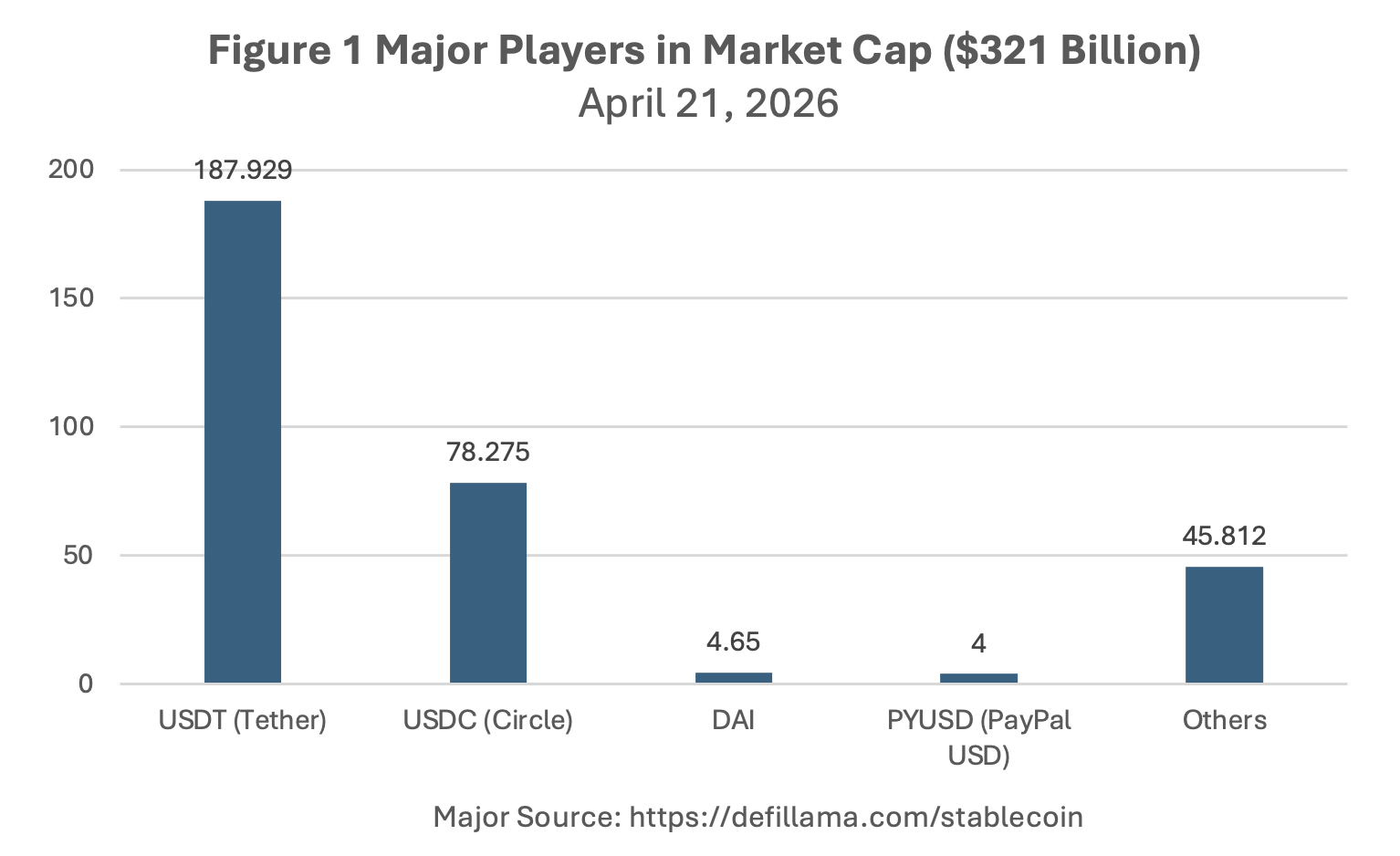
Beyond these two, the next tier of stablecoins is much smaller. Ethena USDe, Dai/DAI (now associated with the Sky ecosystem) and PayPal USD (PYUSD) are among the remaining 10% the market.
In addition to issuers, stablecoins also need the “roads” on which they travel. These roads are provided by crypto exchanges, wallets, payment processors, blockchain networks, and cross-border payout firms. Traditional financial institutions are also experimenting in this area. For example, JPMorgan has promoted JPM Coin as a deposit-token-style system for real-time institutional payments and settlement.
- The “Coin” Part of Stablecoins
A stablecoin is not really a “coin” in the physical sense. It is also not a stand-alone digital coin in the way it is often visualized. The following example shows a simplified data stream of a stablecoin in a readable transaction format (JSON). A stablecoin record has two related layers.
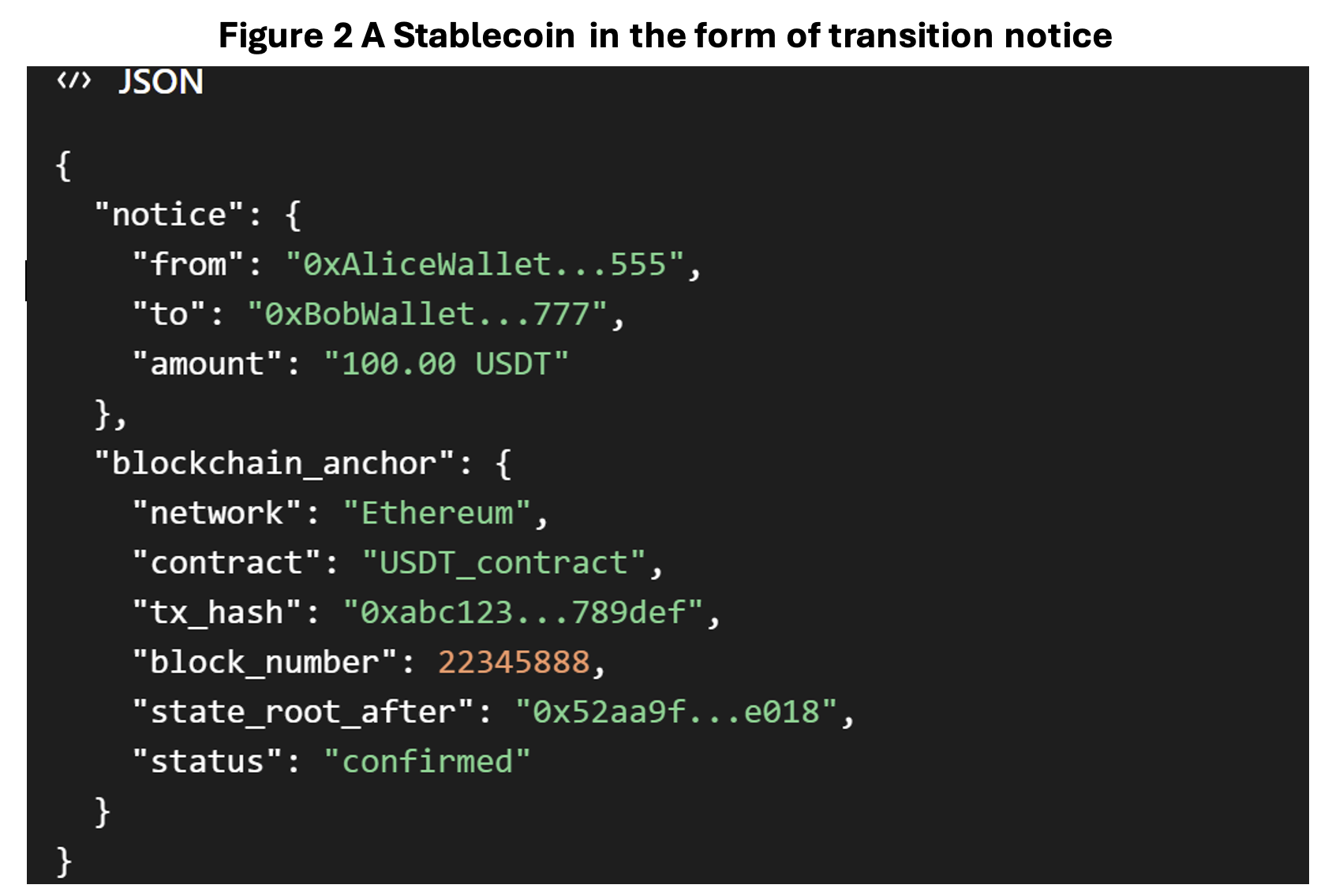
The first layer is the transaction-notice layer. This is the information commonly shown to users or displayed in a readable JSON format. It records the transfer event: who sent the token, who received it, how much was transferred, when the transaction occurred, and through which blockchain network and token contract.
The second layer is the blockchain security and ledger layer. This includes information such as the blockchain network, block number, prior block hash, transaction hash, wallet addresses, digital signatures, and ledger-state verification. This layer is stored and verified by the blockchain system. It is used for security, validation, and consensus. It is not what users normally see on the “surface” when they look at their stablecoin balance.
Therefore, unlike a paper bill, which can circulate anonymously as a stand-along object, a stablecoin is tied to a specific transaction notice and to a ledger record. In this sense, a stablecoin is closer to an issuer-backed digital IOU and payment-notice system than to a free-floating dollar coin or dollar bill.
- The Stable part of the Stablecoins
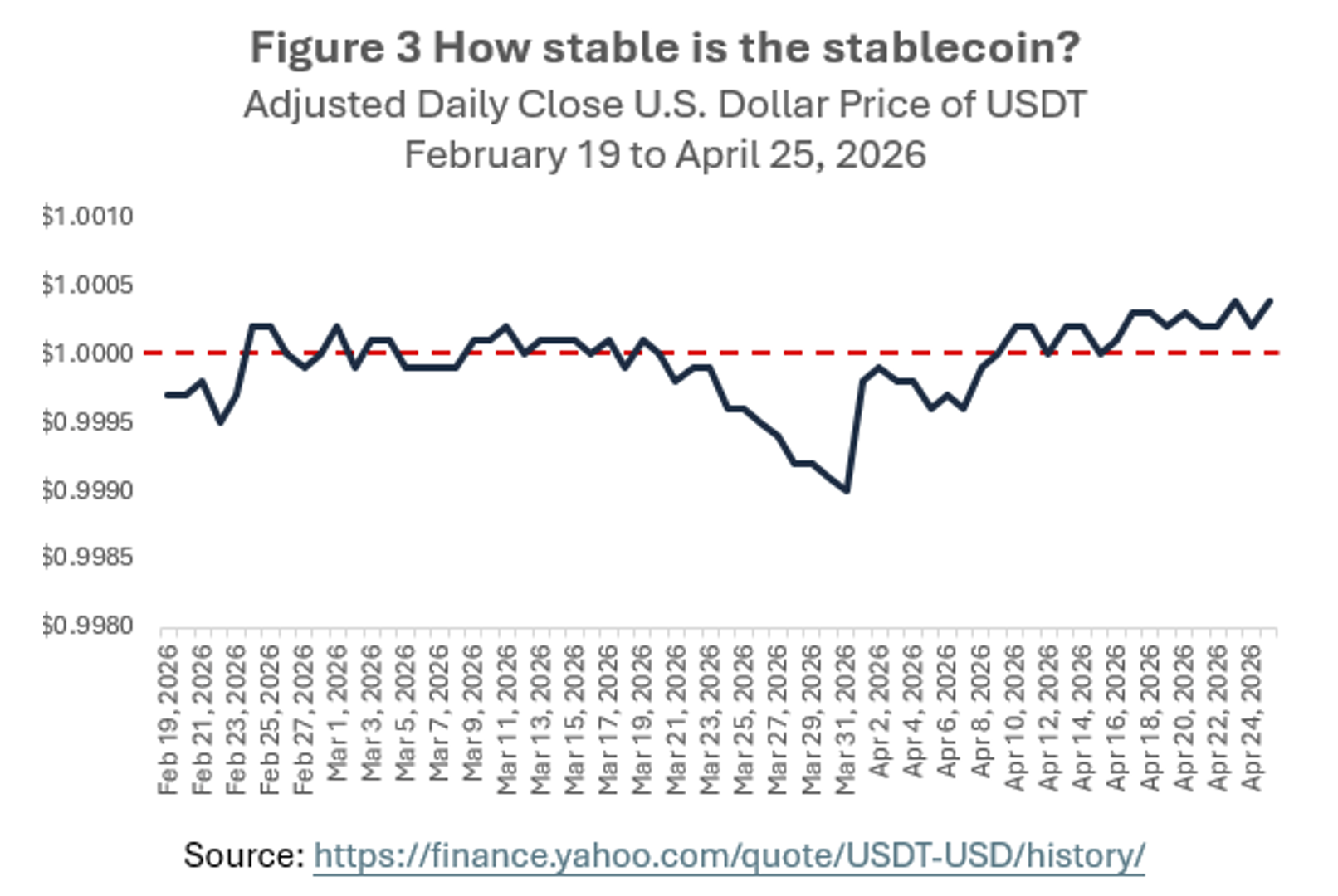
The word “stable” in stablecoin reflects the premise that, unlike cryptocurrencies such as Bitcoin or Ethereum, the issuers promise to redeem the coins at its par values and seek to keep the token’s market price around its intended par value. The following chart shows how stable one major stablecoin, USDT, was from February 19 to April 25, 2026.
To understand the “stable” property, it is useful to separate two concepts: par value and market price.
The par value of a stablecoin is the value the issuer promises to redeem, usually supported by reserve assets. In plain language, the issuer creates tokens and claims to hold safe assets to back them, often cash, bank deposits, Treasury bills, or other short-term U.S. government securities, or other types of cryptos as well. The issuer also promises that eligible holders can redeem the stablecoin at par value, such as 1 token = 1 U.S. dollar.
However, this redemption promise is often subject to important conditions. The issuer may limit direct redemption to approved customers or authorized intermediaries. It may also impose minimum redemption amounts, identity-verification requirements, processing procedures, settlement delays, or fees. Therefore, while the par value is the anchor of the stablecoin, not every holder can necessarily redeem small amounts directly with the issuer at any time.
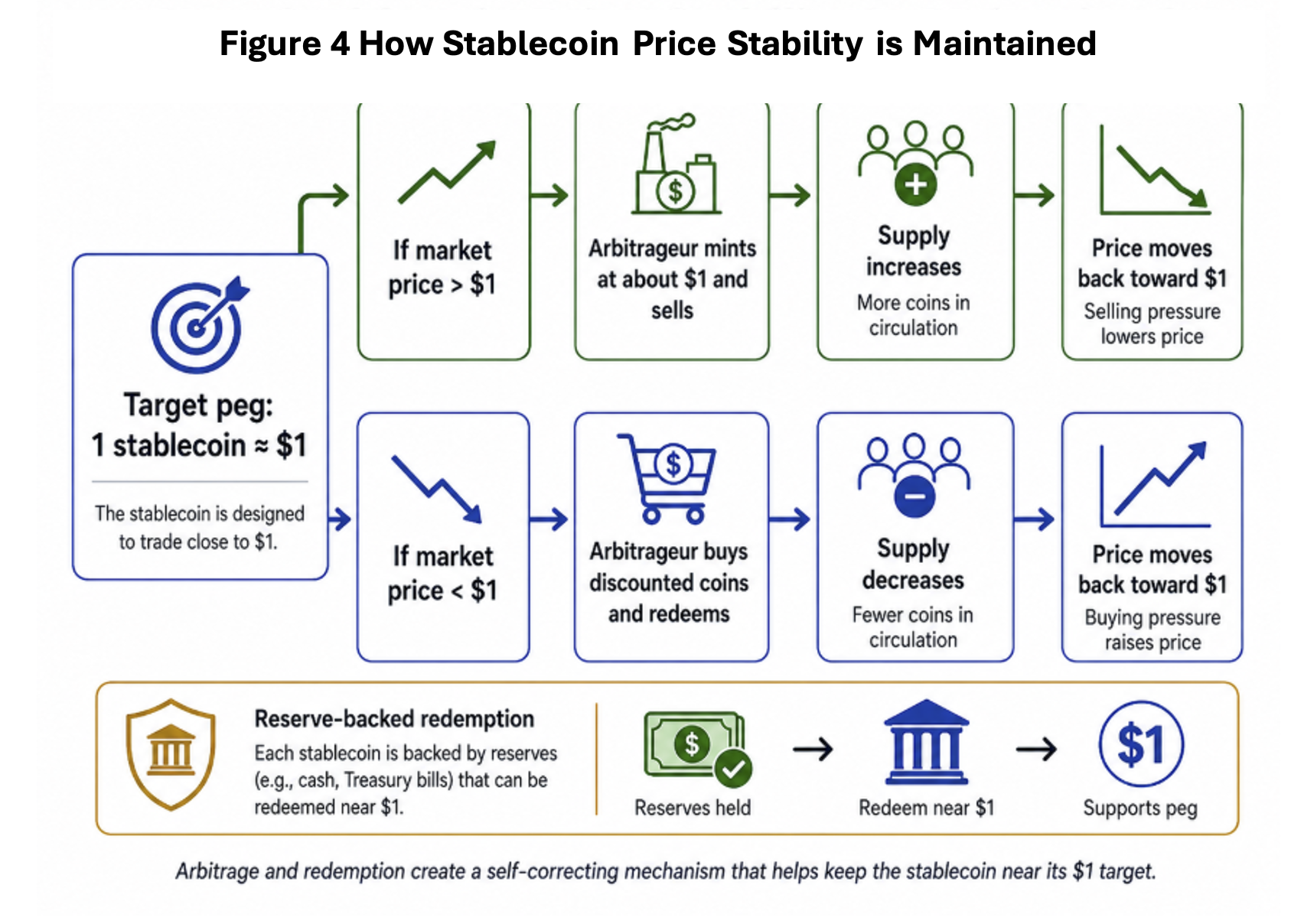
The market price of a stablecoin is the fiat currency value such as USD amount at which it actually trades in its secondary markets, such as crypto exchanges. When the system is working well, market forces help keep the trading price close to par. If the token trades above $1, traders have an incentive to create or acquire new tokens at par and sell them in the market, pushing the price down. If the token trades below $1, traders have an incentive to buy the token cheaply and redeem it, or expect others to redeem it, for $1, pushing the price back up. The chart below illustrates how this arbitrage process helps keep the market price of a stablecoin close to its par value.
Not all stablecoins achieve stability in the same way. Some are backed by reserves, some are backed by other crypto assets, and some attempt to maintain stability through algorithmic or incentive-based mechanisms. In practice, reserve-backed stablecoins dominate today’s market. They are also the type most regulators appear more willing to support because they resemble a familiar financial product: a money-like instrument backed by liquid, relatively safe assets.
- The Life Cycle of the Stablecoins
As illustrated in the following chart, the life cycle of a stablecoin consists of several phases: creation by the issuer, issuance through user purchase, circulation among participants within the stablecoin ecosystem, redemption by the user, and retirement by the issuer.

The issuer creates or mints stablecoin units and publishes the contractual terms governing them. These terms typically include the redemption promise, such as 1:1 redemption, reserve backing, redemption procedures, eligibility requirements, fees, and other conditions.
Users acquire stablecoins by paying sovereign currency, such as U.S. dollars, or by exchanging other crypto assets at their market value in sovereign-currency terms.
After acquiring stablecoins, users may use them in several ways. They may hold them as a store of value, use them to make payments, invest or deploy them in crypto-related financial activities, or redeem them for sovereign currency.
The stablecoins then circulate within the stablecoin ecosystem as they are transferred among users, platforms, exchanges, wallets, merchants, and other participants.
Stablecoins are retired, or “burned,” when a holder redeems them for sovereign currency, either directly from the issuer or through an authorized intermediary. At that point, the issuer removes the redeemed units from circulation and pays out the corresponding sovereign currency according to the redemption terms.
- Use as a New Money-like Tool
Stablecoins began as a tool for crypto users to park value, trade, and move liquidity inside the crypto ecosystem. Today, they are expanding beyond crypto and becoming a broader way to move dollar-like value over the internet. The table below summarizes their main uses.
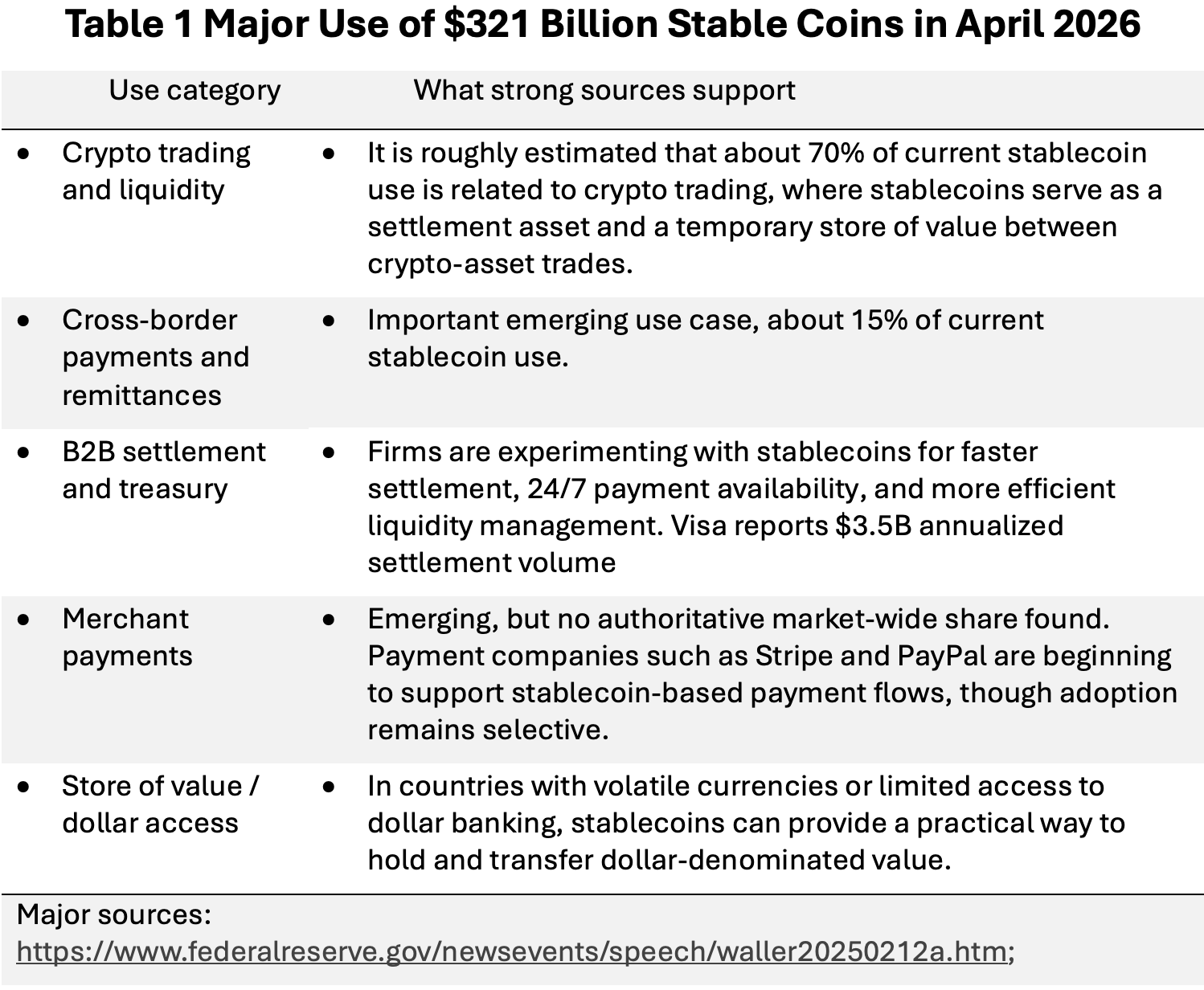
In short, stablecoins are no longer just a crypto-market tool. They are becoming a new money-like payment instrument, especially where speed, global reach, and dollar access matter.
- What Are the Future Trends for Stablecoins?
Stablecoins began mainly as a tool for crypto traders to park value, move liquidity, and settle trades across exchanges within the crypto ecosystem. They are now starting to move from their crypto-market niche toward a broader role in financial infrastructure. However, although stablecoins are no longer just a crypto experiment, they are unlikely to replace banks, card networks, or central bank money in the near future. Instead, they are more likely to become an additional payment and settlement rail operating alongside existing systems.
The future of stablecoins will depend on whether issuers can maintain credible reserves, reliable redemption, safe transaction infrastructure, and regulatory trust. Two issues will be especially important.
First, can stablecoins consistently maintain fiat-like stability while operating in a crypto environment? If issuers can preserve the peg, maintain liquid reserves, and redeem reliably under stress, stablecoins may move closer to mainstream money. If not, they may remain risky crypto instruments.
Second, can stablecoin use expand beyond crypto trading and liquidity management? The key test is whether they gain durable use in payments, remittances, business settlement, and treasury operations. If they do, banks may face deposit migration risk, especially if stablecoins become embedded in major payment apps and platforms.