Khaled Eltokhy and James Orr
June 24, 2026
Job counts in the U.S., New York State and New York City have fully recovered from the Covid-19-related employment collapse though the areas now seem to be in a slower growth mode. New York City’s recent job growth has been somewhat stronger than the others though the pace of growth has varied widely across industries. In this post we examine the performance of key city industries and discuss some of the challenges the city faces in sustaining and expanding employment.
Overall Job Trends
Employment trends in the U.S., New York State and New York City through May of this year. are shown in Figure 1. Over the past year the 0.3% growth in jobs nationwide is well below its usual annual average as is the 0.4% increase in New York State.
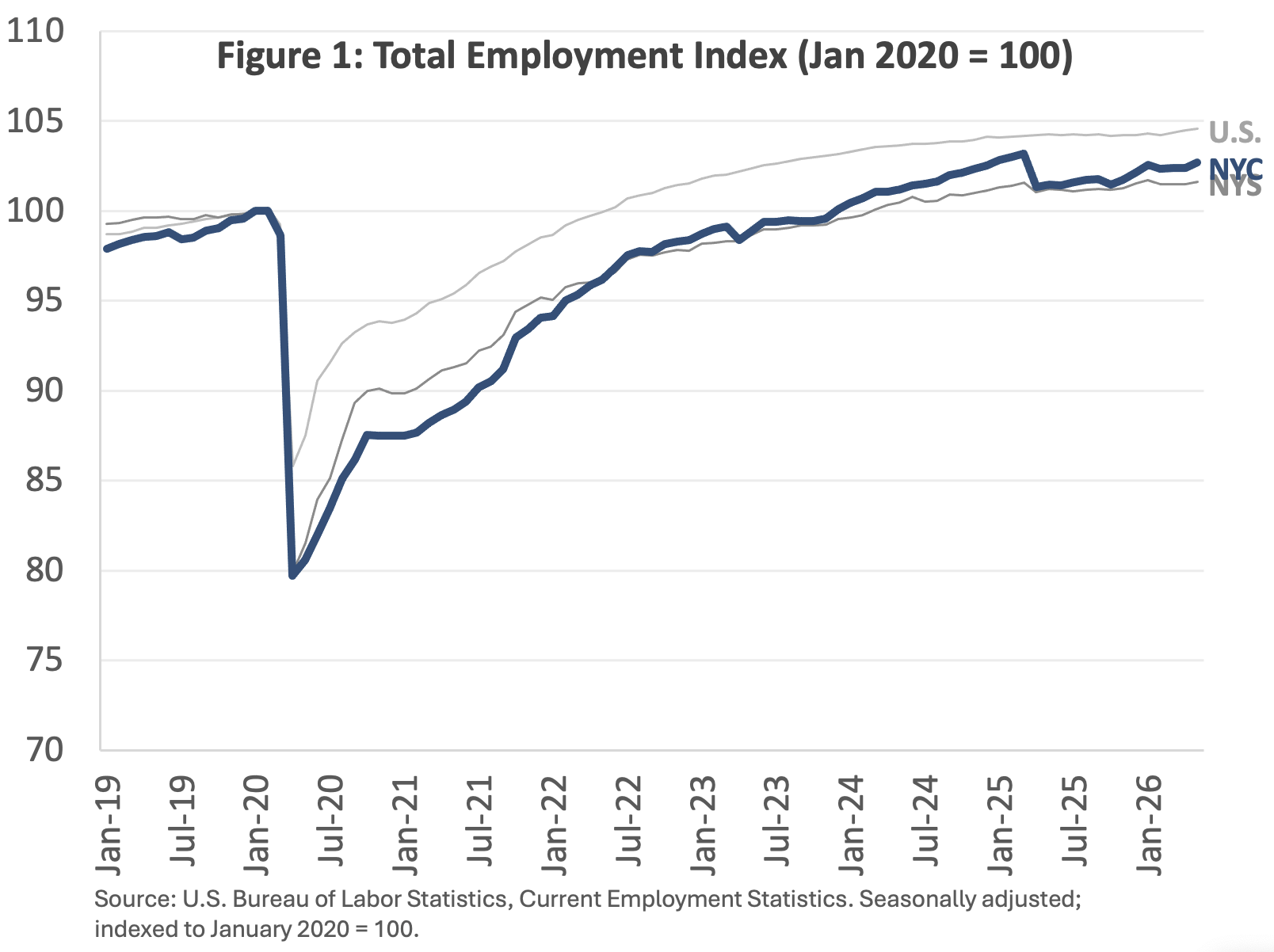
The New York City line shows a notable job decline from March to April of last year, the result of a one-time administrative reclassification of workers in the Health and Social Assistance industry away from New York City to other areas in the state. Over the past year since May, job growth in the city was 1.2% or about 58,000 new jobs. While this growth rate exceeds both the nation and New York State, it is roughly half of the rates seen in the city in the years leading up to the Covid-19 pandemic.
Looking across some key industries in the city in Figure 2, the Healthcare and Social Assistance sector, which employs more than one million workers, added about 23,000 jobs over the past year. The sector’s job performance in the city mirrors a similarly strong job performance nationwide, though many of the new jobs in the city were in the relatively low-paying home health care and individual and family services industries.
By contrast, jobs in the city’s Retail Trade sector were essentially flat over the past yeat and the sector has yet to recover the Covid-19 losses. Department store job losses continue to weigh down the sector with about 6,000 fewer jobs here than a year ago, part of this decline is attributed to the continuing shift to online shopping. The Accomodation and Food Service industry was also flat and jobs remain below pre-Covid 19 levels.
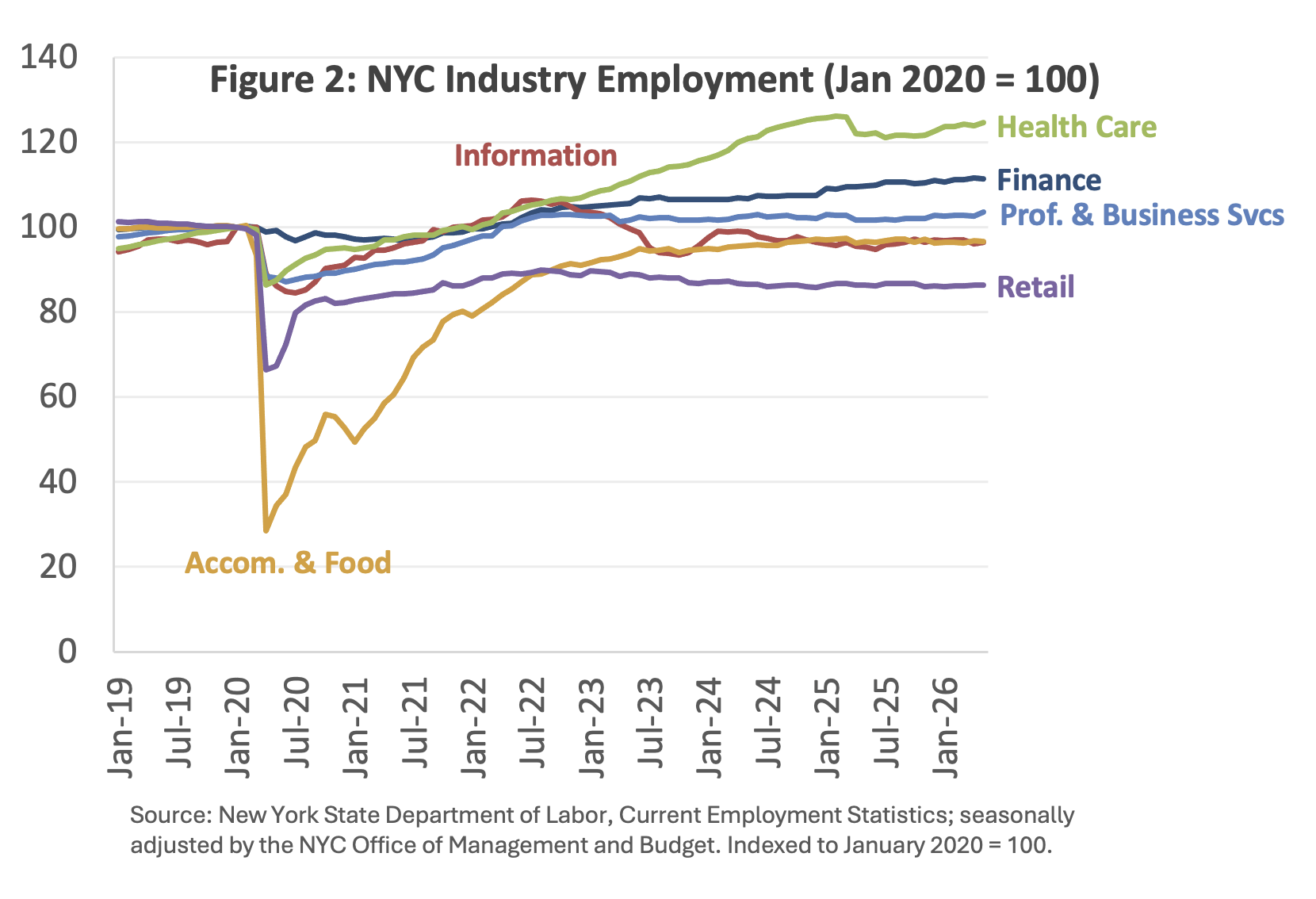 The Finance and Insurance sector added about 6,000 new jobs with many of those added in the securities component, or Wall Street. In the past year Wall Street profits reached $65 billion, the highest on record, and are projected to be strong this year. Another of the city’s key sectors, Professional and Business Services, added about 14,000 jobs, which stands in contrast to some weakness seen nationwide. This industry is a major lessee of office space in the city and contributed to the high level of leasing activity in the first quarter of this year..
Among other sectors, Construction employment was flat, somewhat surprising given the amount of construction one sees going on in the city. Residential building is relatively strong but there is some weakness in the nonresidential and infrastructure components. Employment in the Information sector was up about 2,000 jobs since last May. The telecommunications component continues to shed jobs both nationally and in the city, while in the city there there were some gains in the Publishing and Motion Picture and Sound Recording industries. Federal government employment in the state and city also declined over the past year, associated with the nationwide reductions in the Federal workforce instituted by the Department of Government Efficiency (DOGE).
Unemployment
The city’s 5.4% unemployment rate in May is above its rate of a year ago and its 4.1% rate just prior to the onset of Covid-19. The city’s rate continues to be above both the nation and New York State. Some interesting dynamics underlie recent unemployment trends both nationally and in the city. At the national level, there has been an increase in the unemployment rate of workers aged 22-27 with a college degree. For several decades the unemployment rate for these recent grads has been below the rate for the overall workforce, but over the past four years has risen above it. At the end of last year the rate stood at 5.6 %, more than a full point above the overall rate. `
In New York City a similar pattern emerged. Young college grads (22 – 27) in the city typically have lower rates than young workers without a college degree. In March, however, the situation reversed and the rising unemployment rate of recent grads now exceeds the rate for younger workers without a degree.
The rising unemployment rates of recent college grads is consistent with the discussions of their reduced hiring due to the increasing use of AI in tasks that have been done in the past by young grads. By one measure, hiring has slowed nationally in relatively high-paying occupations with heavier AI usage. However, AI may not be the only factor at play as some analysts have pointed to a role for heightened economic policy uncertainty in reducing the hiring of recent college grads.
Beyond AI’s impact on hiring trends, a recent report examines the longer-term impacts on jobs and revenue in New York City over the next five years based on different scenarios about how the AI revolution could affect output, productivity, profits, jobs and unemployment. They include a benign scenario where AI raises productivity with little job disruption to more worrisome scenarios where AI largely replaces employment. The results show widely different employment outcomes depending on how the AI revolution plays out.
Challenges
Currently, closing the city’s projected $12 combined budget gap for fiscal years 2026 and 2027, as high as $12 billion, has been a focus of the new administration. The city now projects a balanced budget through, among numerous items, revenues from a tax on large second homes or pied-a-terres, additional aid from New York State and cost-saving measures. In its five-year projections, however, the city sees budget gaps developing in fiscal year 2028.
Beyond these local conditions, national policies will feed through to economic activity and jobs in the city and state. How the Federal Reserve sets monetary policy going forward will determine financial conditions and hence investments by businesses and households. The Federal government’s tax, spending and trade policies have and will continue to influence the city’s economy, with potential adverse effects coming from reduced trade flows and Federal government spending in the city for education and infrastructure.
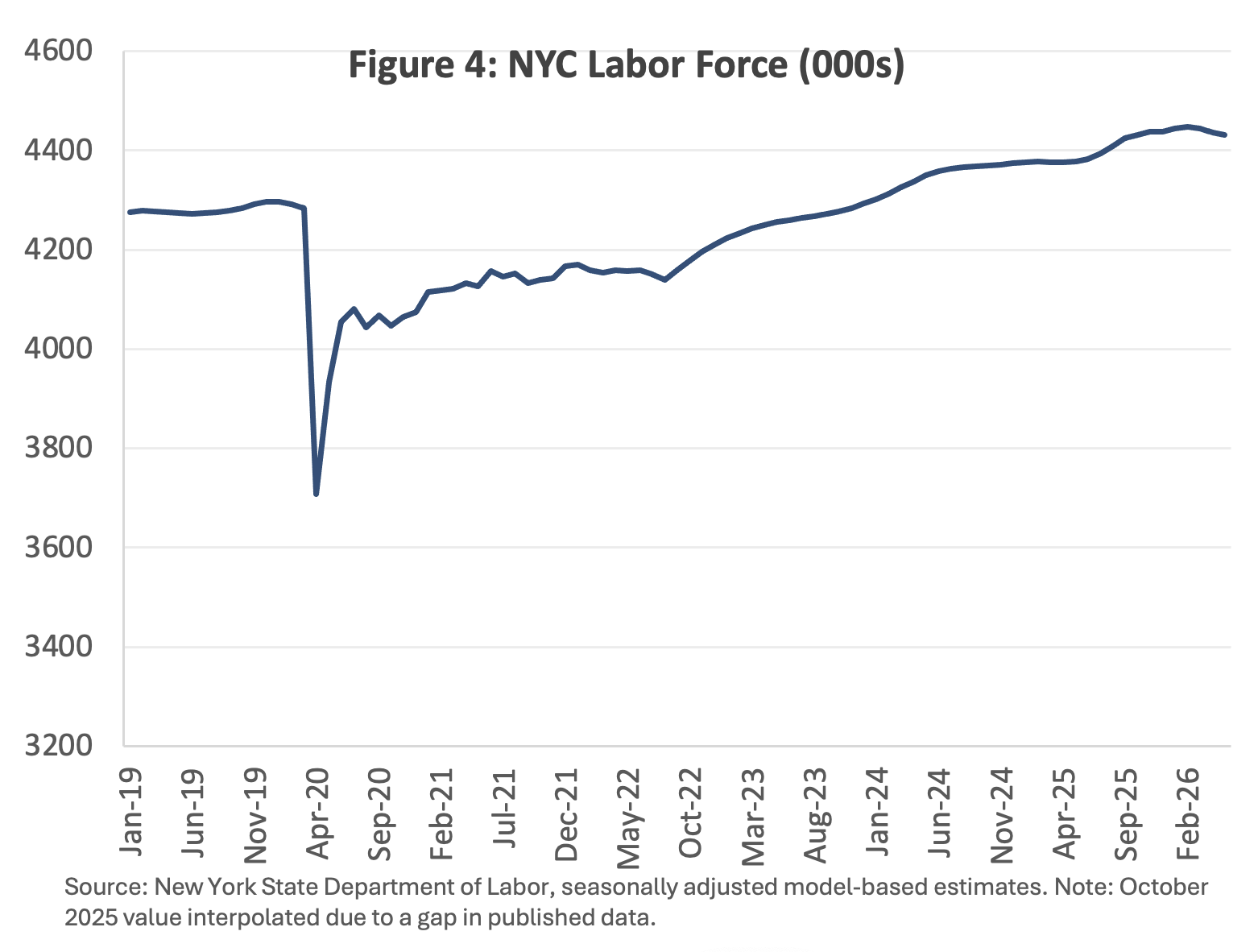
Stricter enforcement of Federal immigration policies and what has been termed historic declines in net international migration will affect New York City’s population and labor force. Currently, over 40% of the city’s population, 65% of the city’s construction workforce and about half of workers in the leisure and hospitality sector are foreign born. Any reduction in the size of the labor force due to reduced immigrant flows could impede activity and employment in industries relying on this source of labor. Notably, as Figure 4 shows, not until the past few months did the city’s labor force decline; in fact, the city’s labor force participation rate has grown to 62.6%, almost a full point above the nation and above its pre-pandemic rate. The rise has been partly driven by the rising rate of female participation which also now exceeds its pre-pandemic rate.
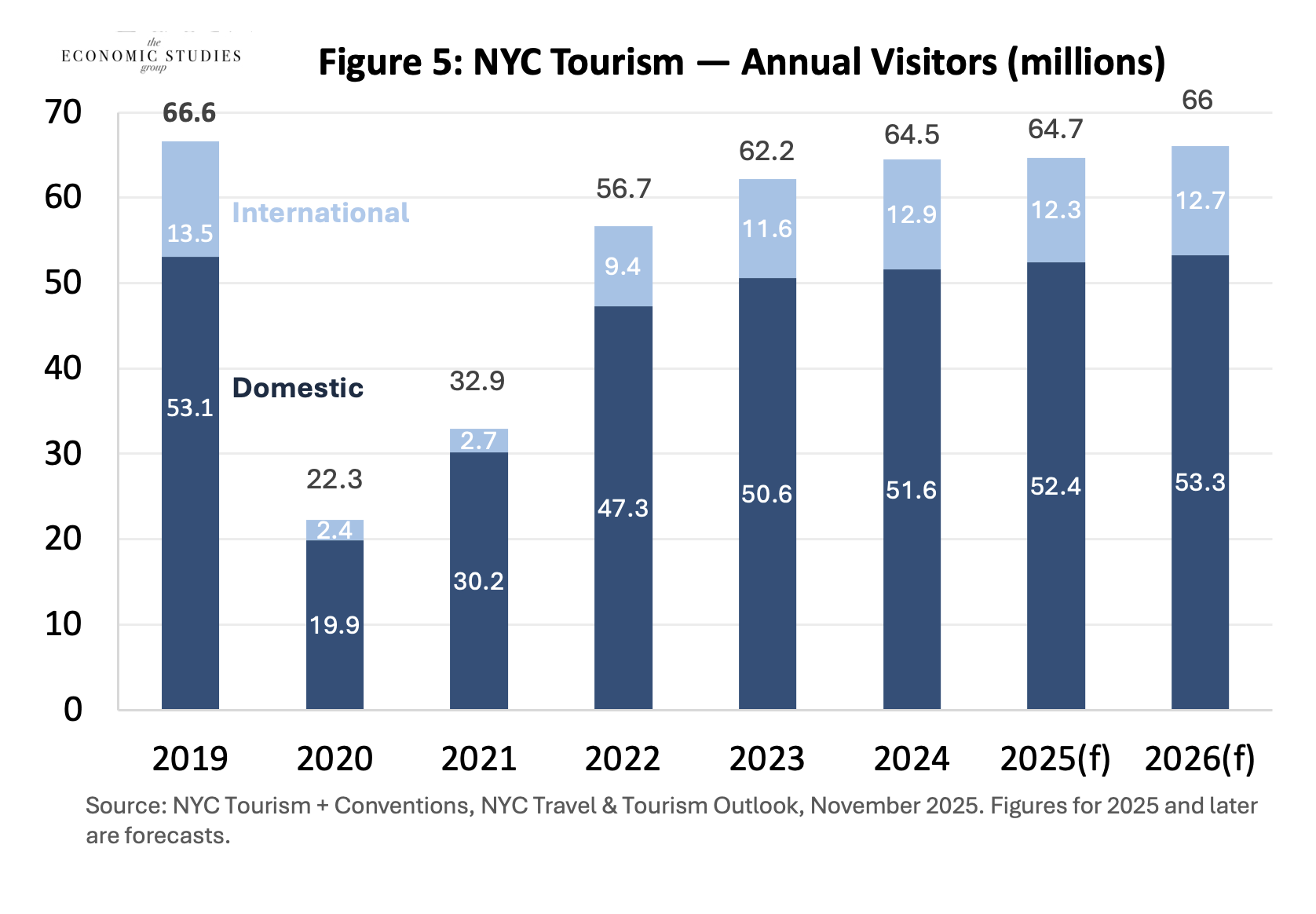
Tourism is another important sector in the city’s economy and affects activity and employment at airports, hotels, restaurants, theaters and museums. In 2019 the city had about 53.1 million domestic visitors and about 13.5 million international visitors. As Figure 5 shows, that number fell sharply during the Covid-19 epidemic.
The large component of international visitors is a feature of tourism flows into New York City. That component declined in 2025 attributed, in part, to fallout from new Federal trade and immigration enforcement policies, with the number of Canadian tourists reportedly down sharply. Despite these disruptions, the number of both domestic and international visitors is projected to increase this year and push the total number of visitors closer to the pre-Covid-19 level.
. 
Prospects
The number of jobs in the city is projected to grow in 2026. Forecasts of the number of new jobs and how individual industries will perform vary. but analysts generally point to several driving forces. Positive signals for growth in employment in office using industries, such as Professional and Business Services, Finance, and Information, are seen in the upturn in office space leasing by these industries. The ongoing strength in Wall Street activity is expected to continue, with potentially large impacts from planned mega-IPOs. The projected increase in the number of tourists should support an expansion of jobs in the leisure and hospitality industry and the accommodation and food service industry. The number of jobs in the city’s large healthcare sector is projected to be stable to slightly rising. On the negative side continued declines are projected for the retail trade sector as is some weakness in the construction and information sectors. As noted, how AI investments and applications play out will be another driving force in the city in the years ahead.